



 Full Games List
 Featured Games
 New Games
 Reviews
 Media
Media Images
 Blogs
Blogs Game Updates
 Images Feedback Summary
 Game Design Highlights
 Tutorials
 Articles
 Scripts
 Utilities / Plugins
 Resources
 Engines
 Engine Bulletins
 What is Makerscore?
 Past Events
 Achievements
 Misaos
 Forums
 Chat
Chat New to RMN?
 Full Store List
 RMN Music Pack (free)



 Profile
 Locker
 Play Lists
KILLER WOLF'S PROFILE
Killer Wolf

1235
 Close
Close
When you're bound by your own convictions, a discipline can be your addiction.
Search
Filter
 All
All Game Pages
 User Statuses
 RMN Battledome! Voting!
BR-O with the speed and attack advantage.
I kind of hope my Wolfbot survives his bracket long enough to get a match with BR-O, I think that would be a fun one!
I kind of hope my Wolfbot survives his bracket long enough to get a match with BR-O, I think that would be a fun one!
Is modular story based game content the way to go?
A good bit of my party "recruiting"/managing comes from my early experiences with Pool of Radiance. You had the option to make up your entire team at the beginning, or to hire them as needed, with a few interesting characters along the way who could join if you had room.
My approach is similar. If the player wants, they can fine tune their entire team from scratch, including assigning alignment and personality types to their creations. They "tag" one of the characters to act as the leader at the start of the module. This is the character they will "directly control", and this character will also gain xp at a slightly increased rate. This xp is separate from the "player xp" which can only be gained by progressing the plot of the individual modules and can be used to transfer gear between different campaigns, as well as for services like a "miraculous" bout of luck that lets a character survive/escape something that should have been fatal, or buying a special one time use technique that can help get them out of trouble. The "personality" settings for the other party members come into play in any conversation/discussion they're in when not being directly player controlled.
The player could also choose to build only their main character from scratch, fleshing the rest of their team out with the available cast of characters. Unlike the player's custom team members, not every unique party member will be available for use in every module.
Since one of the main points of this approach is to focus more on characters and interesting gameplay, I'm leaning towards capping the total number of player built characters in any group to three, so that there will usually be a slot open for a character unique to a given campaign.
Since the whole thing will probably feel a little foreign at first, I'm planning on having a description for each campaign that offers a suggested party. If the player doesn't have anyone who fills one of the recommended roles, they can hire a specialist from the unique cast.
My approach is similar. If the player wants, they can fine tune their entire team from scratch, including assigning alignment and personality types to their creations. They "tag" one of the characters to act as the leader at the start of the module. This is the character they will "directly control", and this character will also gain xp at a slightly increased rate. This xp is separate from the "player xp" which can only be gained by progressing the plot of the individual modules and can be used to transfer gear between different campaigns, as well as for services like a "miraculous" bout of luck that lets a character survive/escape something that should have been fatal, or buying a special one time use technique that can help get them out of trouble. The "personality" settings for the other party members come into play in any conversation/discussion they're in when not being directly player controlled.
The player could also choose to build only their main character from scratch, fleshing the rest of their team out with the available cast of characters. Unlike the player's custom team members, not every unique party member will be available for use in every module.
Since one of the main points of this approach is to focus more on characters and interesting gameplay, I'm leaning towards capping the total number of player built characters in any group to three, so that there will usually be a slot open for a character unique to a given campaign.
Since the whole thing will probably feel a little foreign at first, I'm planning on having a description for each campaign that offers a suggested party. If the player doesn't have anyone who fills one of the recommended roles, they can hire a specialist from the unique cast.
Is modular story based game content the way to go?
For progression, what I was thinking about was having the "player" level up as opposed to just having the characters level up. The experience points the party gain would go into a sort of "bank" that the player can spend in different ways.
Any rare gear that the player finds/earns during the campaigns would go into a sort of storage that transferred between sections. For any "later" campaign, they can take the gear out of storage with no charge. If they wanted to bring it to an "earlier" campaign, they could spend some of their xp bank to transfer the better gear in, but only if it was allowed by the module's spending cap. I'm thinking that the different modules could have different xp spending caps at character generation/outfitting.
I tend to go overboard with attempting to allow non-linear approaches in my games, and it usually makes a ton of extra work for me (an example would be having five copies of every enemy in the game for the scaling difficulty event to assign as appropriate). With the XP buys & spending caps, I can make a set difficulty level for each module, so they can still be a challenge despite me giving the player the freedom to tackle them in any order.
I can use variables and switches to govern the party's abilities. Skills will be tiered, so if a character has 1500 xp worth (access to tier three) of skills (stat boosts/upgrades are going to be counted as "skills", and assigned/removed via events as needed) but is being imported to a module with an 1000xp starting cap, any of their third tier skills/stat boosts would be disabled.
Another possible advantage I see with this setup is that it would be relatively easy to add new content. Instead of always having to write the "next" part of a story, I could just come up with anything that fit the game's overarching theme/setting. If it is "earlier" in the chronology than the player's current save, they can either start a new character for that section (and try out some skills they haven't had access to yet) or import their better developed party members in, once properly governed for the module's spending cap. Also, any xp gained during missions can be spent later, so a lv25 character can still get xp from a lvl 5 module, which they can go ahead and spend in any lv25+ campaign.
I like the idea of a player running his "main" character through a few modules, and then maybe trying out a new character build for a lower level module that isn't really compatible with his current build. He could then bring the new character up through a few adventures, and add him to the team with the original main character to help round out the party's capabilities for later adventures. I guess I'm trying to build in "re-play factor" but in a way that doesn't really have to interrupt the flow of the game, or make the player sit through the same quest sixteen times if they want to try every character build out in the game.
I envision the campaign selection menu as sort of a time line, with a bunch of branches. The player could unlock things that happened in the "past" based on how quests in the present go. This would let them go back and play through those events with new characters, who could later get folded into the "main" party. Even though I'm not really planning one having one constant story tie everything together, I would like for little hints/clues the player finds to unlock newer and more challenging modules for them to tackle.
One example that popped into my head this afternoon was a "later" module that required the player to collect three components of something. Note, I say player. The player's "main" might locate one or two, and maybe a new character finds the third when the player gets around to tackling that section. Now, the new module would be available, but it would require both the characters who carry the components to be in the same party. (Still working on a couple things in my head, like whether a character with 500xp worth of skills/stats should just get handed 1000 free xp when they get introduced into a 1500xp starting cap module, or if they should get a smaller increase.)
It still means a lot of work for me, but hopefully it will prove more engaging and rewarding than duplicating a list of 200 enemies five times has been in the past.
It also sounds like I'm going to have to check SaGa Frontier 2 out at some point!
Any rare gear that the player finds/earns during the campaigns would go into a sort of storage that transferred between sections. For any "later" campaign, they can take the gear out of storage with no charge. If they wanted to bring it to an "earlier" campaign, they could spend some of their xp bank to transfer the better gear in, but only if it was allowed by the module's spending cap. I'm thinking that the different modules could have different xp spending caps at character generation/outfitting.
I tend to go overboard with attempting to allow non-linear approaches in my games, and it usually makes a ton of extra work for me (an example would be having five copies of every enemy in the game for the scaling difficulty event to assign as appropriate). With the XP buys & spending caps, I can make a set difficulty level for each module, so they can still be a challenge despite me giving the player the freedom to tackle them in any order.
I can use variables and switches to govern the party's abilities. Skills will be tiered, so if a character has 1500 xp worth (access to tier three) of skills (stat boosts/upgrades are going to be counted as "skills", and assigned/removed via events as needed) but is being imported to a module with an 1000xp starting cap, any of their third tier skills/stat boosts would be disabled.
Another possible advantage I see with this setup is that it would be relatively easy to add new content. Instead of always having to write the "next" part of a story, I could just come up with anything that fit the game's overarching theme/setting. If it is "earlier" in the chronology than the player's current save, they can either start a new character for that section (and try out some skills they haven't had access to yet) or import their better developed party members in, once properly governed for the module's spending cap. Also, any xp gained during missions can be spent later, so a lv25 character can still get xp from a lvl 5 module, which they can go ahead and spend in any lv25+ campaign.
I like the idea of a player running his "main" character through a few modules, and then maybe trying out a new character build for a lower level module that isn't really compatible with his current build. He could then bring the new character up through a few adventures, and add him to the team with the original main character to help round out the party's capabilities for later adventures. I guess I'm trying to build in "re-play factor" but in a way that doesn't really have to interrupt the flow of the game, or make the player sit through the same quest sixteen times if they want to try every character build out in the game.
I envision the campaign selection menu as sort of a time line, with a bunch of branches. The player could unlock things that happened in the "past" based on how quests in the present go. This would let them go back and play through those events with new characters, who could later get folded into the "main" party. Even though I'm not really planning one having one constant story tie everything together, I would like for little hints/clues the player finds to unlock newer and more challenging modules for them to tackle.
One example that popped into my head this afternoon was a "later" module that required the player to collect three components of something. Note, I say player. The player's "main" might locate one or two, and maybe a new character finds the third when the player gets around to tackling that section. Now, the new module would be available, but it would require both the characters who carry the components to be in the same party. (Still working on a couple things in my head, like whether a character with 500xp worth of skills/stats should just get handed 1000 free xp when they get introduced into a 1500xp starting cap module, or if they should get a smaller increase.)
It still means a lot of work for me, but hopefully it will prove more engaging and rewarding than duplicating a list of 200 enemies five times has been in the past.
It also sounds like I'm going to have to check SaGa Frontier 2 out at some point!
Is modular story based game content the way to go?
An idea occurred to me this afternoon as I was blocking out a section of my game's story for demo purposes. Instead of just starting the player off at the beginning of the game, I was planning on introducing a self contained story that featured characters who were a little more advanced in terms of their skills and abilities, so that the demo could be engaging both plot and gameplay wise.
I wanted to put the best foot forward, not a starting area full of hand holding, fetching, and tons of conversation.
Then I thought, why not just build a game around the best moments it has to offer, instead of all the filler that we've come to expect?
My recent experience with Dragon Age 2 also worked into the mix. The mass produced dungeon approach sort of worked in Mass Effect, where you could easily believe that most of the facilities you ended up traipsing through on "unknown" world missions were just prefabs sold by the same company. Having ten different quests drop you into the same section of real estate, re-purposed to be whatever lair is called for at the moment, in a fantasy setting where it isn't logical to expect someone was selling build-your-own cave kits didn't feel as natural.
I started thinking about how difficult it is for me to generate my own resources. I'm not suggesting I should be able to get away with building one dungeon and just setting up different entry points and treasure drops and call it a game, but that there is no rule saying that more than one story couldn't take place in the same areas. That way, I could get more use out of every resource I produce.
The basic idea is to come up with a number of possible adventures that make use of the resources. Instead of making one overarching game story, I could produce several smaller campaigns. By restricting their scope, I could focus on populating them with (hopefully) more memorable moments and characters.
I could offer the player the chance to "recruit" from stock party member builds, or custom tailor their own party, sort of like how you were able to assemble your teams at the beginning of older games, like the original Pool of Radiance (the one D&D game I actually played on my old Tandy).
The campaign/modules could have assigned difficulty levels and recommended parties. The player would be able to either start new builds at the recommended stat level for the section, and/or import some/all of their existing characters from another module. Modules could be written to favor various approaches, and in the "selection" screen (or whatever I come up with), there could be a brief description, so that the player has the option before hand whether or not they want to start up a campaign that will be heavy on conversation and trade, as opposed to ones that are more focused on combat and action. I could even add in an estimated average time of completion for the modules. I like the idea of focusing on stronger content, and giving the prospective player the option to digest it at their own pace as opposed to just saying "here is a story, play through all of it."
So, does this vignette approach to game making sound like a cop out, or a valid approach?
I wanted to put the best foot forward, not a starting area full of hand holding, fetching, and tons of conversation.
Then I thought, why not just build a game around the best moments it has to offer, instead of all the filler that we've come to expect?
My recent experience with Dragon Age 2 also worked into the mix. The mass produced dungeon approach sort of worked in Mass Effect, where you could easily believe that most of the facilities you ended up traipsing through on "unknown" world missions were just prefabs sold by the same company. Having ten different quests drop you into the same section of real estate, re-purposed to be whatever lair is called for at the moment, in a fantasy setting where it isn't logical to expect someone was selling build-your-own cave kits didn't feel as natural.
I started thinking about how difficult it is for me to generate my own resources. I'm not suggesting I should be able to get away with building one dungeon and just setting up different entry points and treasure drops and call it a game, but that there is no rule saying that more than one story couldn't take place in the same areas. That way, I could get more use out of every resource I produce.
The basic idea is to come up with a number of possible adventures that make use of the resources. Instead of making one overarching game story, I could produce several smaller campaigns. By restricting their scope, I could focus on populating them with (hopefully) more memorable moments and characters.
I could offer the player the chance to "recruit" from stock party member builds, or custom tailor their own party, sort of like how you were able to assemble your teams at the beginning of older games, like the original Pool of Radiance (the one D&D game I actually played on my old Tandy).
The campaign/modules could have assigned difficulty levels and recommended parties. The player would be able to either start new builds at the recommended stat level for the section, and/or import some/all of their existing characters from another module. Modules could be written to favor various approaches, and in the "selection" screen (or whatever I come up with), there could be a brief description, so that the player has the option before hand whether or not they want to start up a campaign that will be heavy on conversation and trade, as opposed to ones that are more focused on combat and action. I could even add in an estimated average time of completion for the modules. I like the idea of focusing on stronger content, and giving the prospective player the option to digest it at their own pace as opposed to just saying "here is a story, play through all of it."
So, does this vignette approach to game making sound like a cop out, or a valid approach?
RMN Battledome! Round Two!
What Videogames Are You Playing Right Now?
To me, the Mass Effect 3 demo felt a lot better than it played. The opening cinematic and everything gave me that familiar, "oh yeah, this is going to be good" vibe, but as soon as I was put in control, things took a rapid downturn.
Maybe it is just because the only other game I've played recently was Dragon Age 2, but it seems like the camera is even further up the protagonist's ass than in Mass Effect 2. I wasn't sure whether I was supposed to be fighting my way through a horde of Batarian Husks or checking Shepard for polyps.
It seems like the default movement speed is even slower than before. There also seems to be more than a little latency in the controls. By the time Shepard finally decided to go into cover, I had already pushed the button a couple more times, thinking it hadn't registered, only to see Shepard vault the cover, and then dive toward the enemy on the other side.
The "rescue the female Krogan" section was okay, but it still feels like everything is running at about 75% speed compared to Mass Effect 2. I also don't like how Shepard has to physically break cover from the wall before he can shoot at the enemy behind him. If I have the camera turned around and the crosshairs on the guy, the game should be intelligent enough to realize that since I'm not facing the cover anymore, I shouldn't still be WELDED TO IT to such a degree that I can't defend myself.
I really wonder if some of the control latency issues are the result of modifications they made to allow Kinect interfacing.
I'm actually not sure where I am on the whole pre-order thing anymore. Initially, my thought was that no game is worth day and date purchase anymore, since they don't last me that long to begin with. During the opening sequence, I started to get that "wow" feeling the first game gave me when I saw it the first time, and pulled up Amazon to put my pre-order through, then I actually played the demo for a while and closed the tab out thinking, maybe I'll wait a bit.
Not sure if that makes it a good demo or a bad one.
Maybe it is just because the only other game I've played recently was Dragon Age 2, but it seems like the camera is even further up the protagonist's ass than in Mass Effect 2. I wasn't sure whether I was supposed to be fighting my way through a horde of Batarian Husks or checking Shepard for polyps.
It seems like the default movement speed is even slower than before. There also seems to be more than a little latency in the controls. By the time Shepard finally decided to go into cover, I had already pushed the button a couple more times, thinking it hadn't registered, only to see Shepard vault the cover, and then dive toward the enemy on the other side.
The "rescue the female Krogan" section was okay, but it still feels like everything is running at about 75% speed compared to Mass Effect 2. I also don't like how Shepard has to physically break cover from the wall before he can shoot at the enemy behind him. If I have the camera turned around and the crosshairs on the guy, the game should be intelligent enough to realize that since I'm not facing the cover anymore, I shouldn't still be WELDED TO IT to such a degree that I can't defend myself.
I really wonder if some of the control latency issues are the result of modifications they made to allow Kinect interfacing.
I'm actually not sure where I am on the whole pre-order thing anymore. Initially, my thought was that no game is worth day and date purchase anymore, since they don't last me that long to begin with. During the opening sequence, I started to get that "wow" feeling the first game gave me when I saw it the first time, and pulled up Amazon to put my pre-order through, then I actually played the demo for a while and closed the tab out thinking, maybe I'll wait a bit.
Not sure if that makes it a good demo or a bad one.
Looking for a Tileset artist for my Star Wars themed project.
Thanks! I guess I'll just have to plant myself back at the drawing board and gut it out the hard way. I'm leaning towards drawing some of the more involved maps as panoramas, and just tacking the bits that need to display "above" the sprites onto a tile-set, since my auto-tile floors panels are usually abysmal.
Inventory hoarding
In my first playthroughs of Mass Effect and Dragon Age, I was constantly hitting the inventory cap. Despite playing a ton of Fallout 1&2 on the computer, I was so used to older games, like Final Fantasy, where you could pretty much pick up everything in the world and not worry about running out of room, that I screamed "bad game design" every time I had to melt down that assault rifle X I wanted to try out, or saw the red text announcing "Inventory Full."
On subsequent trips through those games, I kept only what was useful and sold the rest. I noticed that I never ran into the poverty issues I had my first time through, since I was converting all my useless gear into cold hard currency.
In Dragon Age, I used to hate setting my party members to automatically use a health, stamina, or lyrium potion. I preferred to micro-manage health and stamina/mana myself during big battles, but I still screwed up every now and then and found myself wasting rare injury kits when I wasn't paying attention and had Leliana get felled by a random Carta ambush. I decided enough was enough and set everyone to auto-potion as needed, and then found myself running out of healing items in the late game when I needed them more. To that end, I went back to hoarding potion components, only brewing ten or so of anything at a time to put a limit on how much could be consumed during a normal/elite/boss battle. It happened to work out almost perfectly.
Mass Effect 2 pretty much tanked the whole inventory concept, and aside from desiring more customization options, I got used to the system very quickly.
In Dragon Age 2, I made liberal use of the Junk Item key. Any piece of armor Hawke couldn't use, junked. Any weapon that the team had outgrown? Junked. After almost every mini-quest, I went to a store and sold all of my junk. I routinely found myself with 100+ gold pieces, and invested heartily in Elfroot and Restoration potions (which I ended up using pretty sparingly), as well as the almighty re-spec potion.
Now in Deus Ex games, I am a complete hoarder. I always abused the glitch in the first one that let you stack items over each other. That way I could always have a modified silenced sniper rifle for long shots, a rocket launcher for bots, emp grenades, scrambler grenades, enough lams to scuttle five supertankers, an assault shotgun, a modified Assault Gun with a ton of HE ammo, a stealth pistol, a sawed off shotgun, some zyme, a case full of aug canisters (only auged myself when I ran into a situation I couldn't overcome natrually, which was rarely), and bioelectric cells.
In Human Revolution, I always expand my inventory to the max as soon as possible, even when I end up not using 90% of what I'm carrying based on my play style.
I also tend to hoard experience points/level ups in games that let you control where and when you spend them. In Human Revolution, there were times when I had 13 or more Praxis kits laying around. I always tried to overcome things through reflex and intuition, rather than just modding my legs and leaping over it, or stealthing through a whole level in 30 second increments. (Of course, in later replays, I did a "no Praxis kit left behind" challenge, where I upgraded every time I was awarded one just to see how the game played that way.)
After learning that a lv2 Soldier + lv 18 Jedi was better than the level 7 Scout Level 13 jedi I made the first time, I played Knights of the Old Republic as a scaling low level challenge and went on the do the second game the same way. I'd sit on my level ups until I got to a fight I was having difficulty with, then I'd level my character up one step and see if it was enough to get through (the fact that level ups also restored health might have been a factor here, since I was trying to conserve medkits!) It actually made them more "cinematic", in that boss battles followed the film rule: The good guy was getting his ass handed to him, until he automatically got stronger and fully healed and then handed some of that ass kicking right back.
Of course it made my first fight against Sion on Korriban a wash, since I was trying to bull my way through before I realized I had to erode his will to win. I think I burned through seven levels or something worth of upgrades and healing before I gave up, loaded my last save, and went conversational assassin on him.
On subsequent trips through those games, I kept only what was useful and sold the rest. I noticed that I never ran into the poverty issues I had my first time through, since I was converting all my useless gear into cold hard currency.
In Dragon Age, I used to hate setting my party members to automatically use a health, stamina, or lyrium potion. I preferred to micro-manage health and stamina/mana myself during big battles, but I still screwed up every now and then and found myself wasting rare injury kits when I wasn't paying attention and had Leliana get felled by a random Carta ambush. I decided enough was enough and set everyone to auto-potion as needed, and then found myself running out of healing items in the late game when I needed them more. To that end, I went back to hoarding potion components, only brewing ten or so of anything at a time to put a limit on how much could be consumed during a normal/elite/boss battle. It happened to work out almost perfectly.
Mass Effect 2 pretty much tanked the whole inventory concept, and aside from desiring more customization options, I got used to the system very quickly.
In Dragon Age 2, I made liberal use of the Junk Item key. Any piece of armor Hawke couldn't use, junked. Any weapon that the team had outgrown? Junked. After almost every mini-quest, I went to a store and sold all of my junk. I routinely found myself with 100+ gold pieces, and invested heartily in Elfroot and Restoration potions (which I ended up using pretty sparingly), as well as the almighty re-spec potion.
Now in Deus Ex games, I am a complete hoarder. I always abused the glitch in the first one that let you stack items over each other. That way I could always have a modified silenced sniper rifle for long shots, a rocket launcher for bots, emp grenades, scrambler grenades, enough lams to scuttle five supertankers, an assault shotgun, a modified Assault Gun with a ton of HE ammo, a stealth pistol, a sawed off shotgun, some zyme, a case full of aug canisters (only auged myself when I ran into a situation I couldn't overcome natrually, which was rarely), and bioelectric cells.
In Human Revolution, I always expand my inventory to the max as soon as possible, even when I end up not using 90% of what I'm carrying based on my play style.
I also tend to hoard experience points/level ups in games that let you control where and when you spend them. In Human Revolution, there were times when I had 13 or more Praxis kits laying around. I always tried to overcome things through reflex and intuition, rather than just modding my legs and leaping over it, or stealthing through a whole level in 30 second increments. (Of course, in later replays, I did a "no Praxis kit left behind" challenge, where I upgraded every time I was awarded one just to see how the game played that way.)
After learning that a lv2 Soldier + lv 18 Jedi was better than the level 7 Scout Level 13 jedi I made the first time, I played Knights of the Old Republic as a scaling low level challenge and went on the do the second game the same way. I'd sit on my level ups until I got to a fight I was having difficulty with, then I'd level my character up one step and see if it was enough to get through (the fact that level ups also restored health might have been a factor here, since I was trying to conserve medkits!) It actually made them more "cinematic", in that boss battles followed the film rule: The good guy was getting his ass handed to him, until he automatically got stronger and fully healed and then handed some of that ass kicking right back.
Of course it made my first fight against Sion on Korriban a wash, since I was trying to bull my way through before I realized I had to erode his will to win. I think I burned through seven levels or something worth of upgrades and healing before I gave up, loaded my last save, and went conversational assassin on him.
Taking Some Time Off For Health Reasons
Looking for a Tileset artist for my Star Wars themed project.
I really hate to do this, but I'm tired of running into the same roadblock every time I try to work on this project. I am not very good at making tile-sets. From generating decent looking ground tiles, to stitching the sheet together properly, to getting things to look just right... I'm about equally terrible at all of it.
This is what I have so far.
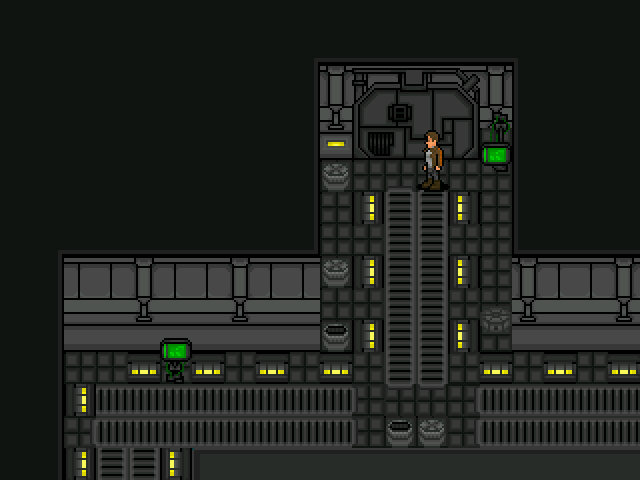
I think my objects (the computer kiosks, the door, and the two types of plasteel item containers) are pretty decent, but the rest of the geometry is severely lacking, with the floor being downright ugly.
Right now, I'm looking for tile-sets to make the first area of the game so I can put a demo together and get some playtesting done on the project before I sink a whole boatload of time and effort into the resource generation for the full game.
I need tiles that would work for:
A run down looking space station with some tiles for a bazaar included.
A decent looking cantina with that Star Wars vibe.
An underworks section with catwalks, and a feeling of overall dis-repair.
If possible, I'd like something that my characters and objects would look good against, so it would almost lean to a more cartoony/outlined aesthetic.
Some characters for reference:

If someone wants to help me out, credit will of course be given, but I am not in a position to pay for resources for a not-for-profit game at this time.
Anyone interested should feel free to PM me if they need/want more details about the project/story/setting. I understand that as deep as the pool of talent runs around here, I'm still likely to have a hard time finding someone to help generate original resources for what boils down to a "fan-game", but I'm giving it a try anyway.
Thank you for your time!
This is what I have so far.
I think my objects (the computer kiosks, the door, and the two types of plasteel item containers) are pretty decent, but the rest of the geometry is severely lacking, with the floor being downright ugly.
Right now, I'm looking for tile-sets to make the first area of the game so I can put a demo together and get some playtesting done on the project before I sink a whole boatload of time and effort into the resource generation for the full game.
I need tiles that would work for:
A run down looking space station with some tiles for a bazaar included.
A decent looking cantina with that Star Wars vibe.
An underworks section with catwalks, and a feeling of overall dis-repair.
If possible, I'd like something that my characters and objects would look good against, so it would almost lean to a more cartoony/outlined aesthetic.
Some characters for reference:
If someone wants to help me out, credit will of course be given, but I am not in a position to pay for resources for a not-for-profit game at this time.
Anyone interested should feel free to PM me if they need/want more details about the project/story/setting. I understand that as deep as the pool of talent runs around here, I'm still likely to have a hard time finding someone to help generate original resources for what boils down to a "fan-game", but I'm giving it a try anyway.
Thank you for your time!
 Games - Tester
 Games - Other
